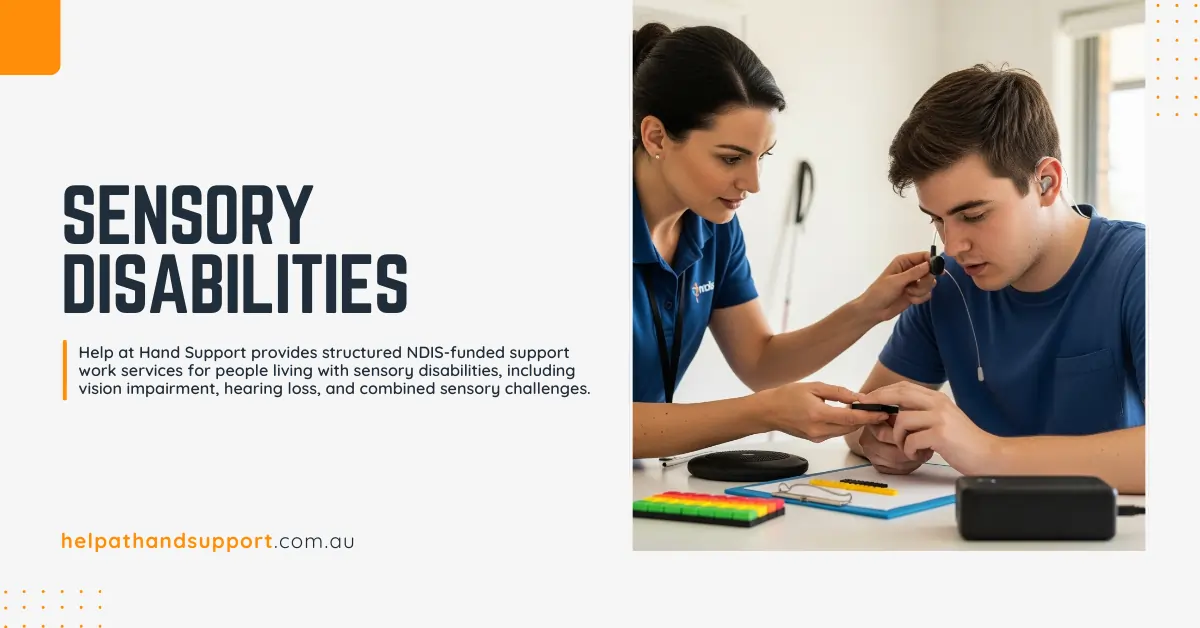
Help at Hand Support provides structured NDIS-funded support work services for people living with sensory disabilities, including vision impairment, hearing loss, and combined sensory challenges.
Services focus on improving independence, accessibility, and safety in accordance with the latest 2026 NDIS Quality and Safeguards Commission standards.
What Does Sensory Disability Support Work Involve?
Sensory disability support work involves personalised, practical assistance that helps participants adapt to their environment and maintain predictable daily routines.
Trained support workers help participants use adaptive tools, develop orientation skills, and apply accessibility strategies for home and community settings.
Each plan is built around measurable NDIS goals to promote safe and confident living.

What Assistive Technologies Are Used in Sensory Support Work?
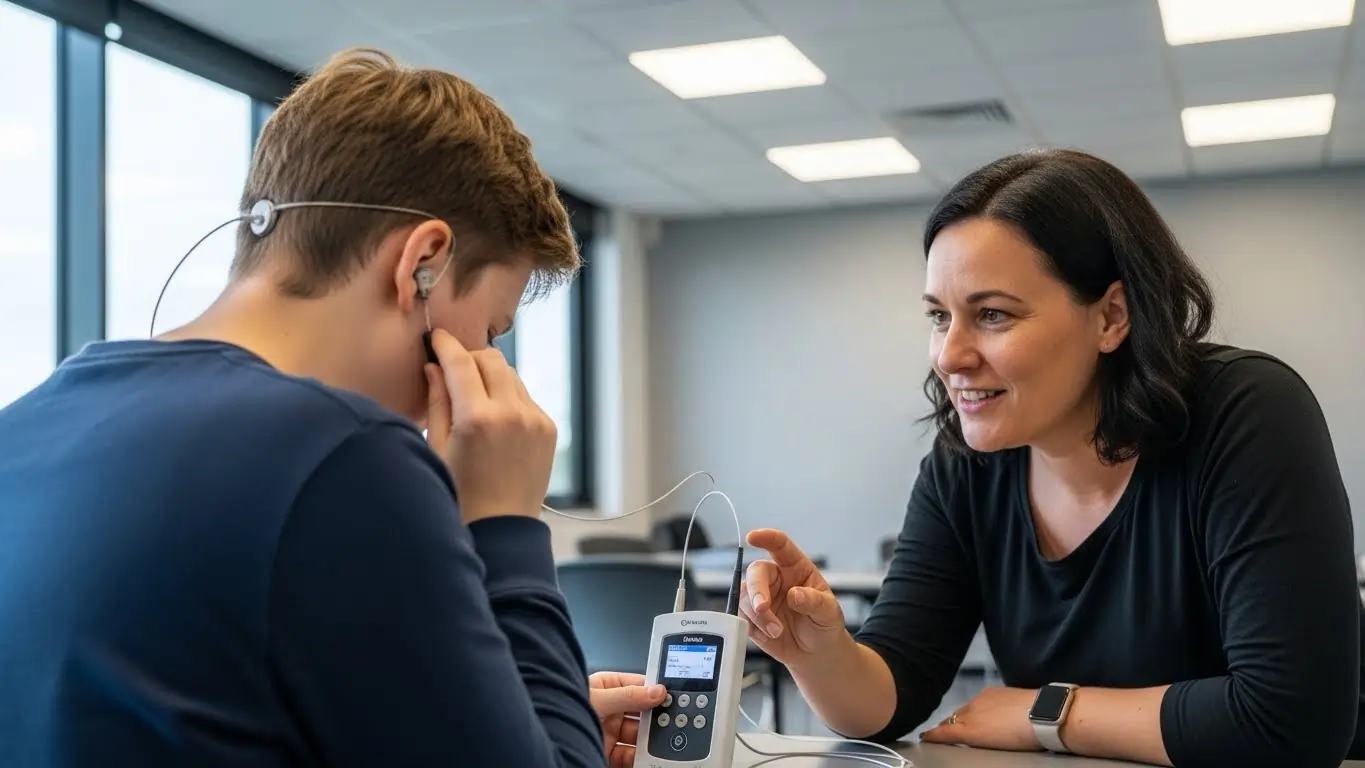
Support workers guide participants in using screen readers, tactile maps, hearing amplifiers, and communication boards to manage everyday activities independently.
These tools enhance environmental awareness, mobility, and social interaction, reinforcing confidence and self-reliance.

How Does Help at Hand Support Assist People with Vision or Hearing Loss?
Help at Hand Support provides structured, adaptive guidance for participants with vision or hearing loss.
Workers deliver orientation and mobility training, coordinate with audiology specialists, and apply sensory adaptation techniques to build consistent routines and environmental familiarity.
What Are the Benefits of Structured Sensory Disability Support?
Structured sensory support increases confidence, safety, and accessibility.
The benefits of Structured Sensory Disability Support are as listed below.
- Greater independence through routine-based skills.
- Improved communication using assistive devices and strategies.
- Enhanced safety during mobility and self-care.
- Reduced stress through predictable daily systems.

How Is Sensory Support Different from Psychosocial Support?
Sensory support focuses on physical interaction, environmental adaptation, and communication accessibility, helping participants manage vision or hearing-related functional challenges.
Psychosocial support, on the other hand, addresses mental health, emotional regulation, and social engagement. Both are funded through the NDIS, but each targets different aspects of daily functioning to promote stability and independence.
What Home Adjustments Help People with Sensory Disabilities?
Home adjustments for people with sensory disabilities include tactile labels, contrast markings, auditory alerts, and adaptive lighting to improve daily accessibility and safety.
Help at Hand Support’s trained support workers help participants identify and apply these modifications to create a more navigable and responsive environment.
Each adjustment is designed to enhance spatial awareness, comfort, and independent living in accordance with NDIS 2026 accessibility standards.

Additional Accessibility and Assistive Adaptation Support
Help at Hand Support provides participants with practical accessibility solutions that enhance communication and safety in familiar settings.
Support workers introduce tactile signage, high-contrast visual markers, and low-vision aids such as magnifiers or adaptive lighting.
For hearing loss, the service covers hearing loop systems, cochlear devices, and digital communication apps meeting the 2025–2026 assistive-technology standards.
Each strategy focuses on hands-on training to ensure participants can confidently use these tools at home and in community settings.
By combining daily-living support with accessibility devices, Help at Hand Support strengthens inclusion under the NDIS 2026 Quality and Safeguards Framework.
How Do Support Workers Ensure Safety During Outdoor Mobility?
Support workers ensure outdoor safety by providing structured mobility training, including route-memory techniques, safe-crossing routines, and practical guidance on the correct use of mobility aids.
Each session is tailored to the participant’s sensory needs, helping them recognise environmental cues, navigate public spaces confidently, and respond safely to real-world challenges.
These skills promote independent and secure community participation in accordance with the NDIS 2026 Practice Standards.

Which NDIS Category Funds Sensory Disability Support?
Sensory disability support is funded under the Core Supports – Assistance with Daily Life and Capacity Building – Improved Daily Living categories of the NDIS.
Each participant’s NDIS plan allocates funding for support worker hours, daily living support, and assistive technology training based on individual functional needs and goals.
This structure ensures that all services remain goal-oriented, measurable, and compliant with the 2026 NDIS Quality and Safeguards Framework.
Who Delivers Sensory Disability Support Services?
Help at Hand Support’s qualified support workers deliver all sensory disability support services with training in audiology awareness, assistive technology, and mobility safety techniques.
Each worker understands the unique needs of participants with vision or hearing impairments and provides hands-on guidance to build independence and confidence in daily living.
Services are delivered in line with the NDIS Practice Standards 2026, ensuring consistency, participant safety, and measurable quality outcomes.
Why Choose Help at Hand Support for Sensory Disability Support?
Help at Hand Support provides structured, participant-centred support work for people living with sensory disabilities, focusing on communication clarity, safety, and independence.
Each plan is tailored to the participant’s sensory needs, ensuring consistent guidance in using assistive devices, navigating safely, and building confidence in daily routines.
Services are delivered across Australia under the 2026 NDIS Quality and Safeguards Framework, promoting measurable outcomes in accessibility, self-reliance, and community participation.
FAQs
What is included in sensory disability support work?
Daily living assistance, mobility training, and communication support for people with vision or hearing impairments.
How do support workers assist participants?
Through guided communication, orientation techniques, and assistive technology training.
Is the service NDIS-funded?
Yes, under Core Supports and Capacity Building categories.
Do you support children and adults?
Yes, plans are customised for all age groups.
Is support available in the community?
Yes, workers assist in real-world settings to reinforce skills beyond the home.
Connecting Sensory Disability Support with Community Participation
Help at Hand Support helps participants with sensory disabilities build confidence and independence through real-world engagement. Support workers provide guided assistance in using mobility aids, communication devices, and orientation techniques to safely explore community environments.
This practical approach complements the organisation’s Community Access Support Services, which focus on inclusive participation, social connection, and independent travel under the NDIS Capacity Building framework.
Together, these supports ensure that participants not only gain functional mobility at home but also develop the confidence to participate in social, educational, and recreational activities across their local communities.
Early engagement helps build consistent routines, enhance communication confidence, and support long-term participation at home and in the community.