Kelly is a participant living with post-traumatic stress disorder, schizophrenia, and depression.
She also manages epilepsy and her mental health conditions with prescribed medication, helping her maintain stability and well-being.
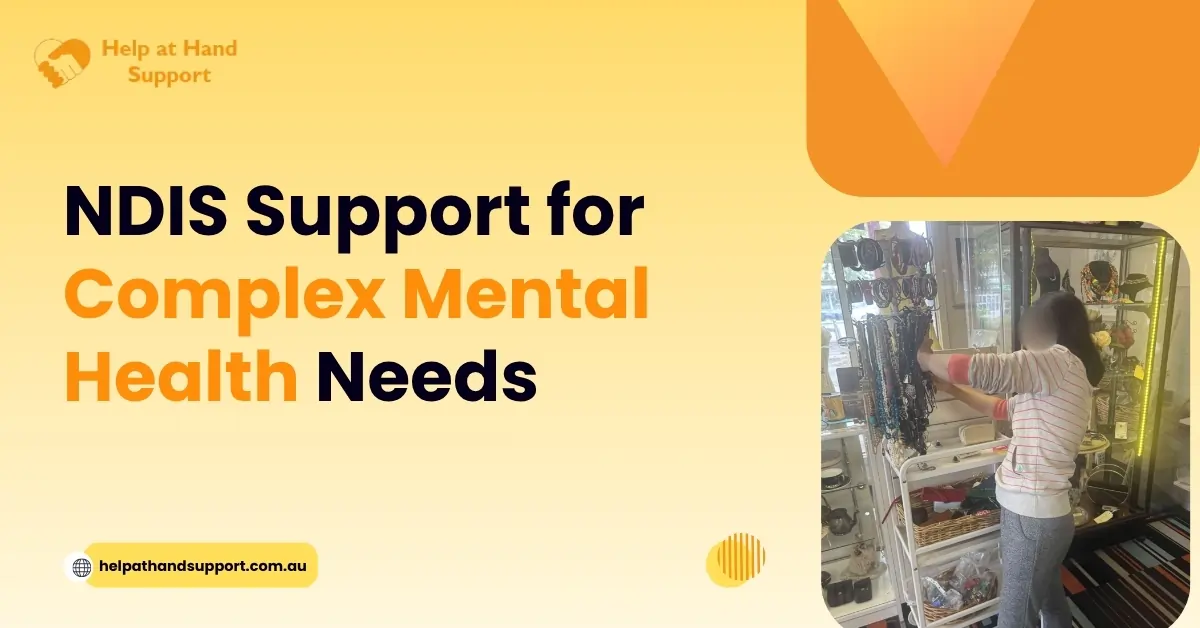
Kelly enjoys attending church on Sundays in Campbelltown, follows a healthy diet after experiencing a past heart attack, and is excited to start her upcoming course.
Help at Hand Support provides personalised care tailored to her needs, offering understanding, encouragement, and assistance with daily tasks.
Our support team stays in close communication with Kelly and her family to ensure she always receives the care, guidance, and support she requires to live independently and enjoy her favourite activities.
How NDIS Mental Health Support Connects to Campbelltown Services
Participants with PTSD, schizophrenia, depression, and epilepsy benefit from structured local care linked to community-based support systems.
Support delivered by Help at Hand Support through NDIS support in Campbelltown ensures consistent assistance with daily living, medication management, and community participation within the Campbelltown service area.
Names and identifying details have been changed, and images have been edited to protect the identity and privacy of NDIS participants. The experiences described reflect real support delivered by Help at Hand Support.
What is Psychosocial Disability and How Does the NDIS Recognise It?
Psychosocial disability refers to the functional impairments that arise from a mental health condition — not the condition itself, but the impact it has on a person’s ability to carry out daily activities, maintain relationships, manage a household, and participate in the community. Conditions such as PTSD, schizophrenia, and depression can all give rise to psychosocial disability, and for participants like Kelly, who manages all three alongside epilepsy, the combined impact on daily life can be significant and complex. The NDIS recognises psychosocial disability as a valid basis for funding, provided the functional impairment is permanent or likely to be permanent. This is an important distinction — NDIS funding for psychosocial disability is not about treating the mental health condition itself (that remains the role of the health system) but about funding the supports that help a person live as independently and fully as possible despite the functional limitations their condition creates. At Help at Hand Support Services, we understand this distinction and build support plans that are genuinely functional and goal-focused, working alongside a participant’s mental health treatment rather than replacing it.
How Help at Hand Supports Participants with Complex Mental Health Needs
Supporting a participant with multiple, co-occurring mental health conditions requires a team that is not only trained but genuinely attuned to the individual. For Kelly, whose conditions include PTSD, schizophrenia, depression, and epilepsy, no two days are exactly the same. Help at Hand Support Services provides consistency, patience, and person-centred care that adapts to how Kelly is feeling on any given day. Our support workers stay in close communication with Kelly and her family, ensuring nothing is missed and that any changes in her presentation are responded to quickly and appropriately. We assist with daily living tasks, medication prompting, transport to community activities including her Sunday church attendance in Campbelltown, and encouragement around her healthy diet and upcoming course. We do not work in isolation — our team coordinates with Kelly’s mental health clinicians, GP, and any other services involved in her care to ensure a joined-up approach that supports her overall wellbeing. The goal is not simply to help Kelly get through each day, but to help her build toward the life she wants.
Managing Epilepsy Alongside Mental Health Conditions with NDIS Support
For participants who manage both a mental health condition and a physical health condition such as epilepsy, support needs to be holistic and safety-aware. Epilepsy can interact with mental health conditions in complex ways — stress, poor sleep, and medication changes can all affect seizure frequency, while seizures themselves can affect mood, cognition, and mental health stability. For Kelly, who manages epilepsy alongside PTSD, schizophrenia, and depression, having a consistent and trained support team is essential for her safety and confidence in daily life. Help at Hand Support Services ensures that workers supporting Kelly understand her epilepsy management plan, know how to respond appropriately in the event of a seizure, and are trained in the relevant first aid protocols. We also support Kelly in maintaining the healthy routines — including her diet and medication schedule — that help keep both her epilepsy and her mental health as stable as possible. Safety in the community, at home, and during activities is always front of mind for our team.
NDIS Psychosocial Support Services in Campbelltown
Participants in Campbelltown and the surrounding south-west Sydney region with complex mental health needs can access structured, plan-aligned NDIS support through Help at Hand Support Services. Our NSW team delivers psychosocial disability support, daily living assistance, community access, personal care, and medication support — all tailored to each participant’s individual plan goals and delivered by experienced, compassionate support workers. We understand that participants with complex mental health diagnoses require a higher level of consistency, communication, and trust-building than a standard support arrangement, and we build our service delivery around those requirements from the outset. Whether you are a participant, a family member, a carer, or a support coordinator looking for a registered NDIS provider with genuine experience in complex psychosocial support, we are here to help. Call our team directly on 1300 822 190 to discuss your needs.
Quick FAQ

Check out more from our Blog
Book A Care Consult
We will be in contact with you shortly