When you first enter the NDIS, the number of new roles, titles, and acronyms can feel overwhelming. Two of the terms people find most confusing are Support Coordinator and Local Area Coordinator — often shortened to SC and LAC. Both help people navigate the NDIS, but they are very different roles with different purposes.
This guide explains what each role does, who funds them, and how to know which one is right for your situation.
What Is a Local Area Coordinator (LAC)?
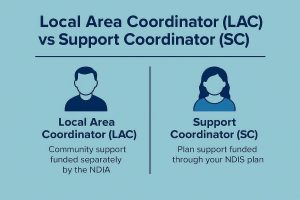
A Local Area Coordinator, or LAC, is a person employed by an NDIA partner organisation. Their job is to help people in their local community connect with the NDIS and with mainstream and community supports. LACs work with a large number of people, which means their contact with any one participant is limited.
LACs are not funded through your NDIS plan — they are funded separately by the NDIA as a community-facing resource. Their primary role is to:
- Help people understand whether they may be eligible for the NDIS
- Support people to apply for the NDIS
- Help participants understand their first NDIS plan
- Connect participants to community and mainstream services
- Support participants with plan reviews if they do not have funded support coordination
LACs are generalists. They are a great starting point, particularly for participants with lower support needs who do not yet have a support network of providers. However, because they manage very large caseloads, the depth of support they can provide to any individual participant is necessarily limited.
What Is a Support Coordinator (SC)?
A Support Coordinator is a professional funded directly through your NDIS plan — specifically through the Support Coordination budget under Capacity Building. Having a Support Coordinator is a specific inclusion in your NDIS plan, and not all participants receive this funding.
Support Coordinators work exclusively for you. Their job is to help you get the most out of your NDIS plan by:
- Connecting you with providers who suit your needs, preferences, and goals
- Setting up service agreements with your providers
- Helping you understand what your funding can be used for
- Supporting you through plan reviews and reassessments
- Helping resolve issues with providers or the NDIA
- Building your capacity to manage your own supports over time
- Coordinating multiple providers so your supports work together
What Is Specialist Support Coordination?
For participants with highly complex needs — such as those at risk of harm, with significant mental health challenges, or requiring intensive coordination across multiple systems — the NDIA can fund Specialist Support Coordination. This is provided by a qualified professional (often a social worker or allied health practitioner) and is designed for situations where standard support coordination is not sufficient.
How Do I Know Which One I Have?
Check your NDIS plan. If you have a budget listed under Support Coordination (CB-SC) in your Capacity Building section, you have funded Support Coordination. If there is no such budget, you will be working with an LAC or a myNDIS Contact instead.
TIP: If you feel your needs are not being met by an LAC and you think you would benefit from dedicated Support Coordination, ask your LAC or NDIA planner to consider including Support Coordination funding in your next plan.
Can I Have Both?
Technically, once you have a Support Coordinator, your LAC steps back and your SC takes the lead. However, your SC and LAC can work together during the transition to a new plan or in certain circumstances. Generally speaking, having funded Support Coordination means you will work primarily with your SC rather than your LAC.
Why Does Having a Good Support Coordinator Matter So Much?
A skilled Support Coordinator does not just coordinate your supports — they advocate for you, help you understand your rights, and ensure your plan is working as hard as possible for you. For participants with complex needs, a great Support Coordinator can be genuinely life-changing.
How Help at Hand Support Services Can Help
While the roles above are funded and delivered in different ways, having the right provider beside you makes all the difference. At Help at Hand Support Services, our experienced team supports participants across Melbourne and nationally, delivering compassionate, professional services to ensure every participant feels genuinely supported.
Ready to get started with Help at Hand Support Services? Call us on 1300 822 190 to speak with our friendly team today.

Check out more from our Blog


Book A Care Consult
We will be in contact with you shortly